Showing posts with label solar cells. Show all posts
Showing posts with label solar cells. Show all posts
Monday, December 12, 2022

Friday, March 12, 2021
Friday, July 11, 2014
First complete theory of how plasmons produce "hot carriers"
The first complete theory of how plasmons produce "hot carriers" has been developed by researchers in the US.
http://physicsworld.com/cws/article/news/2014/jul/10/plasmons-excite-hot-carriers
This research could help enhance solar energy conversion in photo voltaic devices.
http://physicsworld.com/cws/article/news/2014/jul/10/plasmons-excite-hot-carriers
This research could help enhance solar energy conversion in photo voltaic devices.
Sunday, June 15, 2014
Citigroup: How solar module prices could fall to 25c/watt
http://reneweconomy.com.au/2013/citigroup-how-solar-module-prices-could-fall-to-25cwatt-41384
Energy analysts at global investment bank Citigroup suggest that the cost of solar PV modules could fall beyond most expectations in coming years – and reach a cost of just 25c a watt by 2020.
Energy analysts at global investment bank Citigroup suggest that the cost of solar PV modules could fall beyond most expectations in coming years – and reach a cost of just 25c a watt by 2020.
Thursday, May 1, 2014
Large-area luminescent solar concentrators based on ‘Stokes-shift-engineered’ nanocrystals in a mass-polymerized PMMA matrix
http://www.nature.com/nphoton/journal/v8/n5/full/nphoton.2014.54.html
Luminescent solar concentrators are cost-effective complements to semiconductor photovoltaics that can boost the output of solar cells and allow for the integration of photovoltaic-active architectural elements into buildings (for example, photovoltaic windows). Colloidal quantum dots are attractive for use in luminescent solar concentrators, but their small Stokes shift results in reabsorption losses that hinder the realization of large-area devices. Here, we use ‘Stokes-shift-engineered’ CdSe/CdS quantum dots with giant shells (giant quantum dots) to realize luminescent solar concentrators without reabsorption losses for device dimensions up to tens of centimetres. Monte-Carlo simulations show a 100-fold increase in efficiency using giant quantum dots compared with core-only nanocrystals. We demonstrate the feasibility of this approach by using high-optical-quality quantum dot–polymethylmethacrylate nanocomposites fabricated using a modified industrial method that preserves the light-emitting properties of giant quantum dots upon incorporation into the polymer. Study of these luminescent solar concentrators yields optical efficiencies >10% and an effective concentration factor of 4.4. These results demonstrate the significant promise of Stokes-shift-engineered quantum dots for large-area luminescent solar concentrators.
At a glance


READ THE FULL ARTICLE
Additional access options:
Sunday, April 13, 2014
HARRY REID'S SON REPRESENTING CHINESE SOLAR PANEL PLANT IN $5 BILLION NEVADA DEAL
http://www.breitbart.com/Big-Government/2012/09/04/Harry-Reid-s-Son-Representing-Chinese-Solar-Panel-Plant-In-5-Billion-Nevada-Deal
HARRY REID'S SON REPRESENTING CHINESE SOLAR PANEL PLANT IN $5 BILLION NEVADA DEAL
The son of Senate Majority Leader Harry Reid (D-NV), Rory Reid, is the primary representative for ENN Energy Group, a Chinese energy company seeking to build a $5 billion solar panel plant on a 9,000-acre Clark County desert plot in Laughlin, Nevada.
ENN scored big when Clark County commissioners unanimously voted to sell the Chinese company the public land for just $4.5 million, despite the fact that it was appraised at $38.6 million. Sen. Reid has been one of ENN’s biggest supporters, having recruited the company during a 2011 trip to China. According to Reuters, last month Sen. Reid tried to “pressure Nevada's largest power company, NV Energy, to sign up as ENN's first customer.”
Both Rory Reid and Harry Reid deny having ever discussed the $5 billion Chinese solar panel plant deal: "I have never discussed the project with my father or his staff," said Rory Reid. Kristen Orthman, a spokeswoman for the senator, said he had not discussed the project with his son. This isn’t the first time the Reids have come under fire for alleged cronyism. In 2003, allegations emerged that Nevada industries frequently lobbied Sen. Reid through his well-connected relatives.
HARRY REID'S SON REPRESENTING CHINESE SOLAR PANEL PLANT IN $5 BILLION NEVADA DEAL
The son of Senate Majority Leader Harry Reid (D-NV), Rory Reid, is the primary representative for ENN Energy Group, a Chinese energy company seeking to build a $5 billion solar panel plant on a 9,000-acre Clark County desert plot in Laughlin, Nevada.
ENN scored big when Clark County commissioners unanimously voted to sell the Chinese company the public land for just $4.5 million, despite the fact that it was appraised at $38.6 million. Sen. Reid has been one of ENN’s biggest supporters, having recruited the company during a 2011 trip to China. According to Reuters, last month Sen. Reid tried to “pressure Nevada's largest power company, NV Energy, to sign up as ENN's first customer.”
Both Rory Reid and Harry Reid deny having ever discussed the $5 billion Chinese solar panel plant deal: "I have never discussed the project with my father or his staff," said Rory Reid. Kristen Orthman, a spokeswoman for the senator, said he had not discussed the project with his son. This isn’t the first time the Reids have come under fire for alleged cronyism. In 2003, allegations emerged that Nevada industries frequently lobbied Sen. Reid through his well-connected relatives.
Saturday, April 5, 2014
Fwd: Solar energy quantum leap
---------- Forwarded message ----------
From: John Sokol
From: John Sokol
Dreadful article. Nano-tubes are superconductors on a small scale. In practice they have issues, This story is just distorted and misleading.
They article doesn't say how much closer to 100% there is no higher, but we are talking 44% efficiency is the record today.
On Fri, Apr 4, 2014 at 10:36 PM, ST wrote:
If this works, solar energy becomes hyper cheap and hyper efficient. It changes the world:
http://www.ibtimes.co.uk/next-generation-solar-cells-be-100- million-times-more-efficient- 1443251
Thursday, June 14, 2012
Fwd: Best Opportunities in: CPV Solar, Optical Silicone Molding, and Reverse Osmosis
---------- Forwarded message ----------
From: "Nicholas Meyler" <nickm@wdsearch.com>
Date: Jun 14, 2012 5:32 PM
Subject: Best Opportunities in: CPV Solar, Optical Silicone Molding, and Reverse Osmosis
To: <sokol@videotechnology.com>

From: "Nicholas Meyler" <nickm@wdsearch.com>
Date: Jun 14, 2012 5:32 PM
Subject: Best Opportunities in: CPV Solar, Optical Silicone Molding, and Reverse Osmosis
To: <sokol@videotechnology.com>
| ||||||||||||||||||||


Thursday, May 10, 2012
Fwd: NPD Solarbuzz Announces Inaugural China PV Conference in Shanghai, July 19-20
---------- Forwarded message ----------
From: "NPD Solarbuzz News" <news@displaysearch.com>
Date: May 10, 2012 5:07 AM
Subject: NPD Solarbuzz Announces Inaugural China PV Conference in Shanghai, July 19-20
To: <john.sokol@gmail.com>

Santa Clara, Calif. (May 10, 2012)—The solar PV industry is currently at its most critical juncture to date. End-market demand has recorded a blistering compound annual growth rate of 76% since 2007, reaching 27 GW during 2011. However, large corporate losses and high-profile insolvencies are being reported regularly, even from legacy market leaders.
The China PV industry is formulating plans for growth in both the upstream/supply and downstream/demand segments. Decisions made in China today will have a profound impact on every company serving the PV industry. From the amount of polysilicon and raw materials imported into China, to the geographic split of modules exported from the country, all PV stakeholders must understand the key issues driving PV supply and demand into and out of China.
Figure 1: Global Annual PV Industry Demand and Growth Rates

Source: NPD Solarbuzz 2012 Marketbuzz
Leveraging more than a decade of expertise in global PV supply and demand market research, NPD Solarbuzz today announced it will host its inaugural Solarbuzz China PV Conference in Shanghai, China. This two-day event will take place July 19-20, 2012 at the Renaissance Shanghai Yangtze Hotel, and will provide valuable insight and critical market data to help the PV supply chain effectively develop business strategies.
The NPD Solarbuzz China PV Conference is targeted specifically to PV manufacturers, equipment and materials suppliers, developers, industry experts and policy influencers. The conference themes and invited speakers have been chosen specifically to provide the most comprehensive coverage of key factors that have the strongest impact on PV supply, demand and company profitability. The latest market forecast will be covered by prominent NPD Solarbuzz market analysts, while senior executives from the industry's top manufacturers will outline different strategies being used by domestic and global pace-setters.
"Fully understanding the dynamics of global PV supply and demand has become an absolute necessity for any company wishing to navigate the corporate shakeout that is set to last into 2014. When assessing the strongest drivers behind PV supply and demand today, there is no region—or indeed country—that contributes to this analysis with more urgency and relevance than China," noted Finlay Colville, Vice President at NPD Solarbuzz. "We are excited to host our first PV Conference in this key region and share our latest marketing data and insights on the state of the PV market."
During the Solarbuzz China PV Conference, leading PV market analysts from NPD Solarbuzz and senior executives from top-tier manufacturers such as JA Solar, Jinko and Hareon will provide detailed market information and competitive strategies covering the entire PV supply chain. In particular, analysts will explore the most pressing issues affecting the PV industry today, including:
The two-day conference will include over 20 presentations organized into the following six sessions:
About NPD Solarbuzz
NPD Solarbuzz, part of The NPD Group, is a globally recognized market research business focused on solar energy and photovoltaic industries. Since 2001, NPD Solarbuzz has grown its client-base to include many of the largest global PV manufacturers, major investment banks, equipment manufacturers, materials suppliers, hedge fund companies, and a vast range of other multi-nationals. NPD Solarbuzz offers a wide array of reports, including Marketbuzz, an annual global PV industry report, and Solarbuzz Quarterly, which details both historical and forecast data on the global PV supply chain. The company's research also provides annual downstream PV market reports by region for Europe, Asia Pacific and US markets. In addition, Solarbuzz.com is a recognized and respected online resource within the solar industry. For more information, visit www.solarbuzz.com or follow us on Twitter at @Solarbuzz.
About The NPD Group, Inc.
The NPD Group is the leading provider of reliable and comprehensive consumer and retail information for a wide range of industries. Today, more than 1,800 manufacturers, retailers, and service companies rely on NPD to help them drive critical business decisions at the global, national, and local market levels. NPD helps our clients to identify new business opportunities and guide product development, marketing, sales, merchandising, and other functions. Information is available for the following industry sectors: automotive, beauty, commercial technology, consumer technology, entertainment, fashion, food and beverage, foodservice, home, office supplies, software, sports, toys, and wireless. For more information, contact us or visit www.npd.com and www.npdgroupblog.com. Follow us on Twitter at @npdtech and @npdgroup.
Solarbuzz and Marketbuzz are registered trademarks of The NPD Group.
Media Contact:
Lauren Leetun, APR
SAVVY Public Relations
Phone: 407-592-7923
E-mail: media@displaysearch.com
From: "NPD Solarbuzz News" <news@displaysearch.com>
Date: May 10, 2012 5:07 AM
Subject: NPD Solarbuzz Announces Inaugural China PV Conference in Shanghai, July 19-20
To: <john.sokol@gmail.com>
Note to Editors: Solarbuzz's parent company, The NPD Group, recently modified the company references of its member companies. As you may notice in the press release below, Solarbuzz has been re-named "NPD Solarbuzz." We hope you can refer to the updated "NPD Solarbuzz" reference (instead of Solarbuzz) in any articles you are preparing.
NPD Solarbuzz Announces Inaugural China PV Conference in Shanghai, July 19-20
Event to Provide Market Analysis and Industry Forecast of the Solar PV Market in China and GloballySanta Clara, Calif. (May 10, 2012)—The solar PV industry is currently at its most critical juncture to date. End-market demand has recorded a blistering compound annual growth rate of 76% since 2007, reaching 27 GW during 2011. However, large corporate losses and high-profile insolvencies are being reported regularly, even from legacy market leaders.
The China PV industry is formulating plans for growth in both the upstream/supply and downstream/demand segments. Decisions made in China today will have a profound impact on every company serving the PV industry. From the amount of polysilicon and raw materials imported into China, to the geographic split of modules exported from the country, all PV stakeholders must understand the key issues driving PV supply and demand into and out of China.
Figure 1: Global Annual PV Industry Demand and Growth Rates
Source: NPD Solarbuzz 2012 Marketbuzz
Leveraging more than a decade of expertise in global PV supply and demand market research, NPD Solarbuzz today announced it will host its inaugural Solarbuzz China PV Conference in Shanghai, China. This two-day event will take place July 19-20, 2012 at the Renaissance Shanghai Yangtze Hotel, and will provide valuable insight and critical market data to help the PV supply chain effectively develop business strategies.
The NPD Solarbuzz China PV Conference is targeted specifically to PV manufacturers, equipment and materials suppliers, developers, industry experts and policy influencers. The conference themes and invited speakers have been chosen specifically to provide the most comprehensive coverage of key factors that have the strongest impact on PV supply, demand and company profitability. The latest market forecast will be covered by prominent NPD Solarbuzz market analysts, while senior executives from the industry's top manufacturers will outline different strategies being used by domestic and global pace-setters.
"Fully understanding the dynamics of global PV supply and demand has become an absolute necessity for any company wishing to navigate the corporate shakeout that is set to last into 2014. When assessing the strongest drivers behind PV supply and demand today, there is no region—or indeed country—that contributes to this analysis with more urgency and relevance than China," noted Finlay Colville, Vice President at NPD Solarbuzz. "We are excited to host our first PV Conference in this key region and share our latest marketing data and insights on the state of the PV market."
During the Solarbuzz China PV Conference, leading PV market analysts from NPD Solarbuzz and senior executives from top-tier manufacturers such as JA Solar, Jinko and Hareon will provide detailed market information and competitive strategies covering the entire PV supply chain. In particular, analysts will explore the most pressing issues affecting the PV industry today, including:
- Which emerging countries and regions will drive new PV demand out to 2016?
- Which technologies are the key candidates to drive cell efficiencies above 20%?
- What are the leading indicators affecting future ASPs through the PV value chain?
The two-day conference will include over 20 presentations organized into the following six sessions:
- Keynote: Global PV and Supply & Demand
- PV Supply & Equipment: Polysilicon, Wafers and Inverters
- Global PV Markets: Europe, US, Asia Pacific and Emerging Markets
- Manufacturing Technology Innovation
- PV Polices and Project Pipelines
- Leading Country Updates: Germany, US, Japan and China
About NPD Solarbuzz
NPD Solarbuzz, part of The NPD Group, is a globally recognized market research business focused on solar energy and photovoltaic industries. Since 2001, NPD Solarbuzz has grown its client-base to include many of the largest global PV manufacturers, major investment banks, equipment manufacturers, materials suppliers, hedge fund companies, and a vast range of other multi-nationals. NPD Solarbuzz offers a wide array of reports, including Marketbuzz, an annual global PV industry report, and Solarbuzz Quarterly, which details both historical and forecast data on the global PV supply chain. The company's research also provides annual downstream PV market reports by region for Europe, Asia Pacific and US markets. In addition, Solarbuzz.com is a recognized and respected online resource within the solar industry. For more information, visit www.solarbuzz.com or follow us on Twitter at @Solarbuzz.
About The NPD Group, Inc.
The NPD Group is the leading provider of reliable and comprehensive consumer and retail information for a wide range of industries. Today, more than 1,800 manufacturers, retailers, and service companies rely on NPD to help them drive critical business decisions at the global, national, and local market levels. NPD helps our clients to identify new business opportunities and guide product development, marketing, sales, merchandising, and other functions. Information is available for the following industry sectors: automotive, beauty, commercial technology, consumer technology, entertainment, fashion, food and beverage, foodservice, home, office supplies, software, sports, toys, and wireless. For more information, contact us or visit www.npd.com and www.npdgroupblog.com. Follow us on Twitter at @npdtech and @npdgroup.
Solarbuzz and Marketbuzz are registered trademarks of The NPD Group.
Media Contact:
Lauren Leetun, APR
SAVVY Public Relations
Phone: 407-592-7923
E-mail: media@displaysearch.com
If you would rather not receive future communications from Savvy Public Relations, let us know by clicking here.
Savvy Public Relations, Not listed, Orlando, FL 32814 United States
Savvy Public Relations, Not listed, Orlando, FL 32814 United States
Sunday, December 25, 2011
Researchers develop cheap and easy to mass-produce "solar-paint"
From Gizmag:
Researchers develop cheap and easy to mass-produce "solar-paint"


Researchers develop cheap and easy to mass-produce "solar-paint"
By Darren Quick
19:55 December 21, 2011
Mixtures using cadmium sulfide produced yellow paint, cadmium selenide produced dark brown, while a mixture of the two - which offered the best conversion efficiency - was light brown (Photo: ACS Nano)
A team of researchers from the University of Notre Dame in Indiana is reporting the creation of a "solar paint" that could mark an important milestone on the road to widespread implementation of renewable energy technology. Although the new material is still a long way off the conversion efficiencies of commercial silicon solar cells, the researchers say it is cheap to make and can be produced in large quantities.
In an effort to find an alternative to silicon-based solar cells, the Notre Dame researchers turned to quantum dot materials. They started with nanoparticles of titanium dioxide (TiO2) and coated them with either cadmium sulfide or cadmium selenide - both compounds that can absorb photons. A photon of the right energy hitting the cadmium compounds causes an electron to escape, which is absorbed by the TiO2.
The resultant particles were then suspended in a water-alcohol mixture to create a paste. The cadmium sulfide mixture produced a yellow paste, while the cadmium selenide mix produced a dark brown. The most efficient was a mixture of the two that produced a light brown paste.
When the paste was brushed onto a transparent conducting material and exposed to light, it created electricity. To replenish the electrons lost by the cadmium and test the conversion efficiency of the paint-on electrode, cathodes made from other materials and additional compounds were used.
"The best light-to-energy conversion efficiency we've reached so far is 1 percent, which is well behind the usual 10 to 15 percent efficiency of commercial silicon solar cells," explains Prashant Kamat, an investigator in Notre Dame's Center for Nano Science and Technology (NDnano). "But this paint can be made cheaply and in large quantities. If we can improve the efficiency somewhat, we may be able to make a real difference in meeting energy needs in the future."
Kama and his team have christened the new paint "Sun-Believable" and plan to study ways to increase its conversion efficiency and improve its stability. The Notre Dame team's paper is published in the journal ACS Nano.
Monday, December 12, 2011
Indoor solar energy harvesting: a platform to (finally) get some numbers
http://www.limpkin.fr/index.php?post/2011/12/07/Indoor-solar-energy-harvesting%3A-a-platform-to-%28finally%29-get-some-numbers
From: http://hackaday.com/2011/12/12/crunching-the-numbers-using-solar-cells-indoors
Mathieu] was interested in using more solar cells for his everday electronics. He looked around but couldn’t find much information about using pholovoltaic for small indoor devices. We remember hearing some of the same things from [Dave Jones] in one of his EEVblog installments from a few years ago which looked at solar calculators; the only indoor solar gadget we can think of.
From: http://hackaday.com/2011/12/12/crunching-the-numbers-using-solar-cells-indoors
Mathieu] was interested in using more solar cells for his everday electronics. He looked around but couldn’t find much information about using pholovoltaic for small indoor devices. We remember hearing some of the same things from [Dave Jones] in one of his EEVblog installments from a few years ago which looked at solar calculators; the only indoor solar gadget we can think of.
The quest for knowledge was on and [Mathieu] decided to build this indoor solar cell test platform. It’s a stable piece of hardware that allows him to run reliable tests in many different conditions. It’s designed to compare two identical cells. One is charging the Lithium cell, the other is driving a load directly. A second battery powers the platform separately from the solar circuits so that it can be used as a data logger. He collects, dumps, and graphs info from his test runs, then discusses his findings. We won’t spoil it, but the results are not great. Mostly you need sunlight to get real results as it’s just so much more powerful than artificial lighting.
Wednesday, October 19, 2011
Monday, September 26, 2011
Producing Flexible CIGS Solar Cells With Record Efficiency
From http://www.sciencedaily.com/releases/2011/09/110921131729.htm
ScienceDaily (Sep. 23, 2011) — The technology yielding flexible solar cells with an 18.7% record efficiency developed by scientists at Empa, the Swiss Federal Laboratories for Materials Science and Technology, has now been published in Nature Materials. Key to the breakthrough is the control of the energy band gap grading in the copper indium gallium (di)selenide semiconductor, also known as CIGS, the layer that absorbs light and converts it into electricity. The Empa team achieved this by controlling the vapor flux of elements during different stages of the evaporation process for growing the CIGS layer.
High-performance flexible and lightweight solar cells, say, on plastic foils, have excellent potential to lower the manufacturing costs through roll-to-roll processing and the so called "balance-of-system" cost, thus enabling affordable solar electricity in the near future. Thus far, however, flexible solar cells on polymer films have been lacking behind in performance compared to rigid cells, primarily because polymer films require much lower temperatures during deposition of the absorber layer, generally resulting in much lower efficiencies.
The research team at Empa's Laboratory for Thin Film and Photovoltaics, led by Ayodhya N. Tiwari, has been involved in the development of high-efficiency CIGS solar cells on both glass and flexible substrates with a special focus on reducing the deposition temperature of the CIGS layer. The group has repeatedly increased efficiency of flexible CIGS solar cells over the past years -- first at ETH Zurich and now since three years at Empa. With their current record value of 18.7% Tiwari and his team nearly closed the efficiency gap to cells based on multi-crystalline silicon (Si) wafers or CIGS cells on glass. The scientific details of their novel low-temperature deposition technology and the multi-layered device have recently been published in Nature Materials.
"To achieve such high efficiency values, we had to reduce the recombination losses of photo-generated charge carriers," said Tiwari. CIGS layers grown by co-evaporation at temperature of around 450 °C have a strong composition grading because of inadequate inter-diffusion of intermediate phases and preferential diffusion of gallium (Ga) towards the electrical back contact
To overcome this problem doctoral students Adrian Chirilă and Patrick Bloesch developed novel processes for optimizing the solar cell performance. To achieve an appropriate composition profile in the CIGS layer -- for enabling more efficient charge carrier collection and reduced interface recombination -- Chirilă and colleagues developed an innovative growth process by carefully controlling the Ga and indium (In) evaporation flux during different stages of the evaporation process.
High-efficiency solar cells -- grown on cheap metal-foils
Such high-efficiency CIGS solar cells up to now were developed only on glass substrates with processes where CIGS layers are grown at temperatures of 600 °C or above. In contrast, polymer foils cannot withstand such high temperatures. The low-temperature process now developed by Tiwari and Co. not only yielded an 18.7%-efficiency cell on polymer foils but also another record efficiency of 17.7% on steel foil without any diffusion oxide or nitride barrier layer commonly used in high-temperature processes. Both efficiencies were independently certified by the Fraunhofer Institute for Solar Energy Systems (ISE) in Freiburg, Germany. "We have thus shown that this low-temperature process is also applicable on low-cost metal foils such as aluminum or Mild-steel, achieving comparably high-efficiency cells and indicating a severe cost reduction potential with this technology," said Tiwari.
Scientists at FLISOM, a start-up company, and Empa have been collaborating to further develop low-temperature processing, and FLISOM is scaling up the technology for roll-to-roll manufacturing of monolithically interconnected solar modules and commercializing the technology. The research has been supported by the Swiss National Science Foundation (SNSF), the Commission for Technology and Innovation (CTI), the Swiss Federal Office of Energy (SFOE), EU Framework Programmes as well as by Swiss companies W. Blösch AG and FLISOM.
ScienceDaily (Sep. 23, 2011) — The technology yielding flexible solar cells with an 18.7% record efficiency developed by scientists at Empa, the Swiss Federal Laboratories for Materials Science and Technology, has now been published in Nature Materials. Key to the breakthrough is the control of the energy band gap grading in the copper indium gallium (di)selenide semiconductor, also known as CIGS, the layer that absorbs light and converts it into electricity. The Empa team achieved this by controlling the vapor flux of elements during different stages of the evaporation process for growing the CIGS layer.
High-performance flexible and lightweight solar cells, say, on plastic foils, have excellent potential to lower the manufacturing costs through roll-to-roll processing and the so called "balance-of-system" cost, thus enabling affordable solar electricity in the near future. Thus far, however, flexible solar cells on polymer films have been lacking behind in performance compared to rigid cells, primarily because polymer films require much lower temperatures during deposition of the absorber layer, generally resulting in much lower efficiencies.
The research team at Empa's Laboratory for Thin Film and Photovoltaics, led by Ayodhya N. Tiwari, has been involved in the development of high-efficiency CIGS solar cells on both glass and flexible substrates with a special focus on reducing the deposition temperature of the CIGS layer. The group has repeatedly increased efficiency of flexible CIGS solar cells over the past years -- first at ETH Zurich and now since three years at Empa. With their current record value of 18.7% Tiwari and his team nearly closed the efficiency gap to cells based on multi-crystalline silicon (Si) wafers or CIGS cells on glass. The scientific details of their novel low-temperature deposition technology and the multi-layered device have recently been published in Nature Materials.
"To achieve such high efficiency values, we had to reduce the recombination losses of photo-generated charge carriers," said Tiwari. CIGS layers grown by co-evaporation at temperature of around 450 °C have a strong composition grading because of inadequate inter-diffusion of intermediate phases and preferential diffusion of gallium (Ga) towards the electrical back contact
To overcome this problem doctoral students Adrian Chirilă and Patrick Bloesch developed novel processes for optimizing the solar cell performance. To achieve an appropriate composition profile in the CIGS layer -- for enabling more efficient charge carrier collection and reduced interface recombination -- Chirilă and colleagues developed an innovative growth process by carefully controlling the Ga and indium (In) evaporation flux during different stages of the evaporation process.
High-efficiency solar cells -- grown on cheap metal-foils
Such high-efficiency CIGS solar cells up to now were developed only on glass substrates with processes where CIGS layers are grown at temperatures of 600 °C or above. In contrast, polymer foils cannot withstand such high temperatures. The low-temperature process now developed by Tiwari and Co. not only yielded an 18.7%-efficiency cell on polymer foils but also another record efficiency of 17.7% on steel foil without any diffusion oxide or nitride barrier layer commonly used in high-temperature processes. Both efficiencies were independently certified by the Fraunhofer Institute for Solar Energy Systems (ISE) in Freiburg, Germany. "We have thus shown that this low-temperature process is also applicable on low-cost metal foils such as aluminum or Mild-steel, achieving comparably high-efficiency cells and indicating a severe cost reduction potential with this technology," said Tiwari.
Scientists at FLISOM, a start-up company, and Empa have been collaborating to further develop low-temperature processing, and FLISOM is scaling up the technology for roll-to-roll manufacturing of monolithically interconnected solar modules and commercializing the technology. The research has been supported by the Swiss National Science Foundation (SNSF), the Commission for Technology and Innovation (CTI), the Swiss Federal Office of Energy (SFOE), EU Framework Programmes as well as by Swiss companies W. Blösch AG and FLISOM.
Friday, July 29, 2011
MIT Unveils Sun-Free Photovoltaics
From Slashdot:
"Researchers at MIT just unveiled a new solar power generator that doesn't need sunlight to function. The button-sized power generator can tap energy from heat, the sun's rays, a hydrocarbon fuel, or a decaying radioisotope, and it can run three times longer than a lithium-ion battery of the same weight. It is hoped that the technology may one day be used to generate power for spacecraft on long-term missions where sunlight may not be available."
"Researchers at MIT just unveiled a new solar power generator that doesn't need sunlight to function. The button-sized power generator can tap energy from heat, the sun's rays, a hydrocarbon fuel, or a decaying radioisotope, and it can run three times longer than a lithium-ion battery of the same weight. It is hoped that the technology may one day be used to generate power for spacecraft on long-term missions where sunlight may not be available."
Wednesday, July 13, 2011
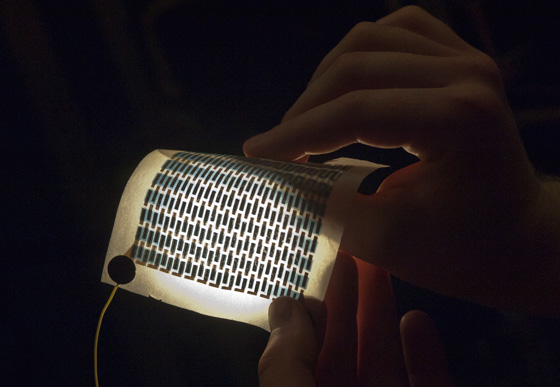
Dynamic folding of a paper solar cell circuit
A paper solar cell circuit is dynamically folded and unfolded while the voltage is simultaneously measured on the meter. The paper photovoltaic is illuminated from below with simulated solar illumination.
MIT Researchers Crack The Code On Cheaply Printing Solar Cells On Paper, Fabric Now panels can be made lightweight, cheaply, and cleanly. It could be the first step in revolutionizing how we generate solar power.
From Fastcompany: MIT Researchers Crack The Code On Cheaply Printing Solar Cells On Paper, Fabric
From Slashdot:
"Following up on earlier work in the field, researchers at MIT are developing a process to print solar cells directly onto many common forms of paper. 'The technique represents a major departure from the systems used until now to create most solar cells, which require exposing the substrates to potentially damaging conditions, either in the form of liquids or high temperatures. The new printing process uses vapors, not liquids, and temperatures less than 120 degrees Celsius. These "gentle" conditions make it possible to use ordinary untreated paper, cloth or plastic as the substrate on which the solar cells can be printed. ... The resilient solar cells still function even when folded up into a paper airplane.'"
Wednesday, January 6, 2010
Super Efficient Next-Generation Solar Cells From Nanotubes
From Technology Review
Carbon nanotube photovoltaics can wring twice the charge from light.
Today’s solar cells lose much of the energy in light to heat. Now researchers at Cornell University have made a photovoltaic cell out of a single carbon nanotube that can take advantage of more of the energy in light than conventional photovoltaics. The tiny carbon tubes might eventually be used to make more-efficient next-generation solar cells.
“The main limiting factor in a solar cell is that when you absorb a high-energy photon, you lose energy to heat, and there’s no way to recover it,” says Matthew Beard, a senior scientist at the National Renewable Energy Laboratory in Golden, CO. Loss of energy to heat limits the efficiency of the best solar cells to about 33 percent. “The material that can convert at a much higher efficiency will be a
game-changer,” says Beard.
Researchers led by Paul McEuen, professor of physics at Cornell, began by putting a single nanotube in a circuit and giving it three electrical contacts called gates, one at each end and one underneath. They used the gates to apply a voltage across the nanotube, then illuminated it with light. When a photon hits the nanotube, it
transfers some of its energy to an electron, which can then flow through the circuit off the nanotube. This one-photon, one-electron process is what normally happens in a solar cell. What’s unusual about the nanotube cell, says McEuen, is what happens when you put in what he calls “a big photon” — a photon whose energy is twice as big as the energy normally required to get an electron off the cell. In
conventional cells, this is the energy that’s lost as heat. In the nanotube device, it kicks a second electron into the circuit. The work was described last week in the journal Science.
There’s evidence that another class of nanomaterials called quantum dots can also convert the energy of one photon into more than one electron. However, making operational quantum-dot cells that can do this has proved a major hurdle, says Beard, whose lab, led by Arthur Nozik, is working on the problem. One of the challenges with quantum-dot solar is that it’s very difficult to get the freed electrons to leave the quantum dot and enter an external circuit. “The system is teasing you; you can’t get those charge carriers out, so what’s the point?” says Ji Ung Lee, professor of nanoscale engineering at the State University of New York in Albany. “McEuen’s group has shown this in a system where you can get the extra carriers out.”
McEuen cautions that his work on carbon nanotube photovoltaics is fundamental. “We’ve made the world’s smallest solar cell, and that’s not necessarily a good thing,” he says. To take advantage of the nanotubes’ superefficiency, researchers will first have to develop methods for making large arrays of the diodes. “We’re not at a point where we can scale up carbon nanotubes, but that should be the ultimate goal,” says Lee, who developed the first nanotube diodes while a researcher at General Electric.
It’s not clear why the nanotube photovoltaic cell offers this two-for-one energy conversion. “It’s mysterious to us,” says McEuen. However, the most likely reason is that while conventional solar materials have only one energy level for electrons to move through, carbon nanotubes have several. And two of them just happen to be very well matched: one of the energy levels, or bandgaps, is twice as high as the other. “We may have gotten lucky, and it has very little to do with the fact that it’s a carbon nanotube,” says McEuen. This means,
McEuen hopes, that even if it proves too challenging to make arrays of nanotube solar cells, materials scientists can look for pairs of materials that have these kinds of matched bandgaps, and layer them to
make solar cells that do with two materials what the single nanotube cells can do. “Maybe the answer won’t be in nanotubes, but in another pair of materials,” McEuen says.
Carbon nanotube photovoltaics can wring twice the charge from light.
Today’s solar cells lose much of the energy in light to heat. Now researchers at Cornell University have made a photovoltaic cell out of a single carbon nanotube that can take advantage of more of the energy in light than conventional photovoltaics. The tiny carbon tubes might eventually be used to make more-efficient next-generation solar cells.
“The main limiting factor in a solar cell is that when you absorb a high-energy photon, you lose energy to heat, and there’s no way to recover it,” says Matthew Beard, a senior scientist at the National Renewable Energy Laboratory in Golden, CO. Loss of energy to heat limits the efficiency of the best solar cells to about 33 percent. “The material that can convert at a much higher efficiency will be a
game-changer,” says Beard.
Researchers led by Paul McEuen, professor of physics at Cornell, began by putting a single nanotube in a circuit and giving it three electrical contacts called gates, one at each end and one underneath. They used the gates to apply a voltage across the nanotube, then illuminated it with light. When a photon hits the nanotube, it
transfers some of its energy to an electron, which can then flow through the circuit off the nanotube. This one-photon, one-electron process is what normally happens in a solar cell. What’s unusual about the nanotube cell, says McEuen, is what happens when you put in what he calls “a big photon” — a photon whose energy is twice as big as the energy normally required to get an electron off the cell. In
conventional cells, this is the energy that’s lost as heat. In the nanotube device, it kicks a second electron into the circuit. The work was described last week in the journal Science.
There’s evidence that another class of nanomaterials called quantum dots can also convert the energy of one photon into more than one electron. However, making operational quantum-dot cells that can do this has proved a major hurdle, says Beard, whose lab, led by Arthur Nozik, is working on the problem. One of the challenges with quantum-dot solar is that it’s very difficult to get the freed electrons to leave the quantum dot and enter an external circuit. “The system is teasing you; you can’t get those charge carriers out, so what’s the point?” says Ji Ung Lee, professor of nanoscale engineering at the State University of New York in Albany. “McEuen’s group has shown this in a system where you can get the extra carriers out.”
McEuen cautions that his work on carbon nanotube photovoltaics is fundamental. “We’ve made the world’s smallest solar cell, and that’s not necessarily a good thing,” he says. To take advantage of the nanotubes’ superefficiency, researchers will first have to develop methods for making large arrays of the diodes. “We’re not at a point where we can scale up carbon nanotubes, but that should be the ultimate goal,” says Lee, who developed the first nanotube diodes while a researcher at General Electric.
It’s not clear why the nanotube photovoltaic cell offers this two-for-one energy conversion. “It’s mysterious to us,” says McEuen. However, the most likely reason is that while conventional solar materials have only one energy level for electrons to move through, carbon nanotubes have several. And two of them just happen to be very well matched: one of the energy levels, or bandgaps, is twice as high as the other. “We may have gotten lucky, and it has very little to do with the fact that it’s a carbon nanotube,” says McEuen. This means,
McEuen hopes, that even if it proves too challenging to make arrays of nanotube solar cells, materials scientists can look for pairs of materials that have these kinds of matched bandgaps, and layer them to
make solar cells that do with two materials what the single nanotube cells can do. “Maybe the answer won’t be in nanotubes, but in another pair of materials,” McEuen says.
Monday, October 19, 2009
major advance in organic plastic solar cells
FROM Facebook: Josie Roman - I've been talking about this research for a while since it has been going on for several years. Now we have some serious results. This is a major advance in organic plastic solar cells.
"Gains in speed, quality and current over conventional production techniques hold promise for both research and commercial production. Professor Guillermo Bazan and a team of postgraduate researchers at UC Santa Barbara's Center for Polymers and Organic Solids (CPOS) today announced a major advance in the synthesis of organic polymers for plastic solar cells. Bazan's team: reduced reaction time by 99%, from 48 hours to 30 minutes, and increased average molecular weight of the polymers by a factor of more than 3.
The reduced reaction time effectively cuts production time for the organic polymers by nearly 50%, since reaction time and purification time are approximately equal in the production process, in both laboratory and commercial environments.
The higher molecular weight of the polymers, reflecting the creation of longer chains of the polymers, has a major benefit in increasing current density in plastic solar cells by as much as a factor of more than four. Over polymer batches with varying average molecular weights, produced using varying combinations of the elements of the new methodology, the increase in current density was found to be approximately proportional to the increase in average molecular weight."
"Gains in speed, quality and current over conventional production techniques hold promise for both research and commercial production. Professor Guillermo Bazan and a team of postgraduate researchers at UC Santa Barbara's Center for Polymers and Organic Solids (CPOS) today announced a major advance in the synthesis of organic polymers for plastic solar cells. Bazan's team: reduced reaction time by 99%, from 48 hours to 30 minutes, and increased average molecular weight of the polymers by a factor of more than 3.
The reduced reaction time effectively cuts production time for the organic polymers by nearly 50%, since reaction time and purification time are approximately equal in the production process, in both laboratory and commercial environments.
The higher molecular weight of the polymers, reflecting the creation of longer chains of the polymers, has a major benefit in increasing current density in plastic solar cells by as much as a factor of more than four. Over polymer batches with varying average molecular weights, produced using varying combinations of the elements of the new methodology, the increase in current density was found to be approximately proportional to the increase in average molecular weight."
Source: www.nature.com
Nature Chemistry offers a unique mix of news and reviews alongside top-quality research papers. Published monthly, in print and online, the journal reflects the entire spectrum of chemistry, pure and applied.
Thursday, October 8, 2009
Solar cells using tiny spheres of silicon

Focusing Light on Silicon Beads
Placing tiny spheres of silicon in reflective trays could be the key to cheap, efficient solar cells.
Spherical solar cells were originally proposed by Texas Instruments about 30 years ago, says Branz. But while they had the potential to reduce the amount of silicon used, they brought with them a host of new problems. Their curved surfaces, for example, can cause more light to be reflected, which reduces their efficiency. What's more, only half of the sphere ends up actually being exposed to light. Significant gaps also tend to form between the spheres when arranged in arrays, which can further reduce the efficiency of the solar cell.
Process for producing crystalline silicon spheres - Patent 4637855
Method of isolating shorted silicon spheres - US Patent 5192400
Method of making doped silicon spheres - US Patent 5278097
Solar Energy: Popcorn-ball Design Doubles Efficiency Of Dye-sensitized Solar Cells
porous spheres are able to manipulate light and more than double the efficiency of converting solar energy to electricity.
Spheral Solar Will Start Production In 2004 Where did these guys go?

Video Sphere Renewable Energy Corp forms Buckeye Silicon joins Toledo solar business
Video Buckeye Silicon
Very odd that I can not find a web site for either company.
Contacts listed: Jim Calhoun, 419-893-9600 & Mark Erickson, 714-497-9499
Companies doing this.
Clean Venture 21 (CV21), Kyoto, Japan.
Sphere Renewable Energy Corp. (SREC), California
Buckeye Silicon (BeSi), Toledo, OH
Spheral Solar Power (now gone?) - A division of ATS Automation Tooling Systems , Ontario, Canada
Subscribe to:
Posts (Atom)
